Beaumont, CA • Garbage Disposal Repair
Garbage Disposal Repair in Beaumont, CA
A disposal that hums but will not turn, is jammed, leaks, or will not start is a disposal that needs a repair, not a replacement on the spot. We repair garbage disposals across Beaumont, clear jams, and test the drain after the work.
24/7 emergency line • Local Beaumont coverage • Clear diagnosis first
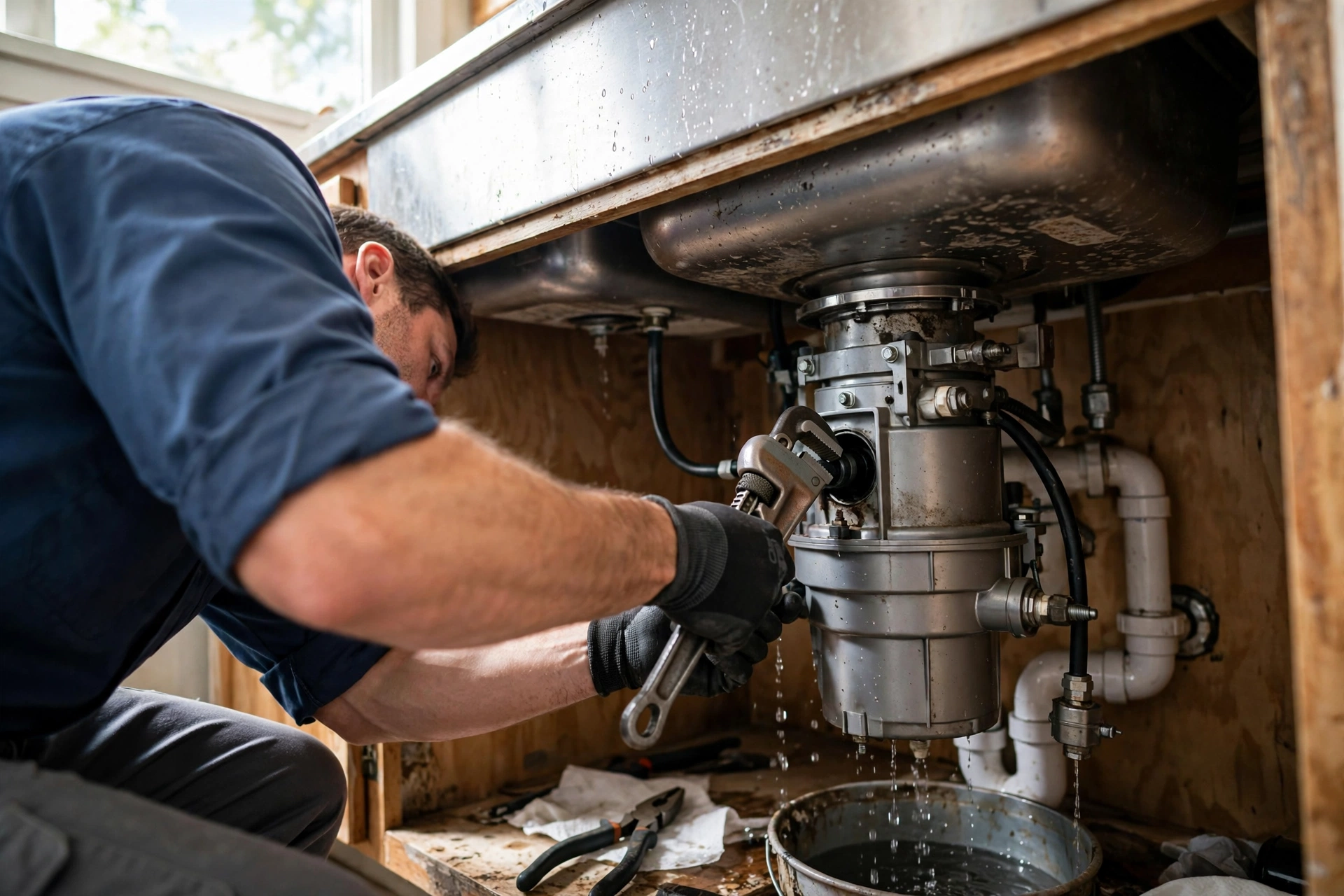
Garbage disposal repair is the work of fixing the unit under the kitchen sink that grinds food scraps and sends them down the drain. The disposal is a small motor with a grinding plate, a seal where it meets the sink, and a drain connection to the trap. When it jams, hums, leaks, or will not start, the kitchen sink backs up with it, because the disposal sits in the drain path. A disposal fault and a clogged sink often arrive together, and the visit sorts out which one came first.
Repair starts with what the disposal does when it is switched on, not with the unit itself. A disposal that hums but will not turn is jammed. A disposal that does nothing at all has no power or a failed motor. A disposal that runs but the sink still drains slowly has a clog past the unit. Each pattern points to a different fix, and the visit follows the pattern.
Disposal Hums but Will Not Turn
A disposal that hums but will not turn is jammed. The motor is trying to turn the grinding plate and cannot, because something is caught between the plate and the wall of the unit. The hum is the motor straining against the jam. The fix is to switch the disposal off, clear the jam, and turn the plate by hand from below until it moves freely, then switch the unit back on and test it with running water.
The jam is usually food: a bone, a fruit pit, a piece of fibrous vegetable, or a spoon that slipped down the drain. Bones and pits are the most common jams, because they are hard enough to stop the plate and small enough to slip past the drain cover. Fibrous vegetables like celery and artichoke wrap around the plate and stop it the same way. The jam is cleared from the top of the unit or from below, and the plate is turned until it moves without catching.
Jammed Disposal: What Caused It and What to Do
A jammed disposal is usually caused by something the disposal was not built to grind. Bones, fruit pits, shells, and coffee grounds are the usual jams, along with fibrous vegetables that wrap around the plate instead of grinding. Grease poured down the disposal coats the plate and the drain below it, and the coating holds food in place until the plate cannot turn. A disposal that jams often is usually being fed things it cannot handle.
The first step with a jammed disposal is to switch it off and check the power. Some disposals have a reset button on the bottom of the unit, and a jam that trips the overload will reset once the jam is cleared and the button is pressed. Check the drain too: a disposal that is jammed will not pass water, so the sink backs up behind it, and the standing water has to be bailed before the jam can be reached.
Clearing a jam means reaching the plate and turning it by hand until it moves freely. The disposal is switched off at the wall switch and at the breaker before any hand goes near it, because the plate can start without warning while power is connected. Once the plate turns freely, the unit is switched back on with cold water running, and a small amount of soft food is ground to test it. A disposal that grinds normally after a jam was cleared needed only the jam removed. Call Beaumont Kitchen Sink Pros at (951) 555-0100 and describe what the disposal does when you switch it on, and we will connect you with an available local crew right away.
Leaks at the Disposal
A disposal leaks in one of three places: at the seal where it meets the sink, at the drain connection to the trap, or from the body of the unit itself. A leak at the sink seal appears as water dripping from the top of the unit, where it mounts under the basin. A leak at the drain connection appears as water dripping from the pipe where it leaves the disposal. A leak from the body of the unit appears as water coming from the casing itself, and that usually means a seal inside the unit has failed.
A leak at a connection is often a worn seal or a loose joint, and the fix is a new seal and a joint tightened to seal. A leak from the body of the unit is a different fix: the seal inside the unit has failed, and the unit needs a repair or a replacement. The visit traces the leak first, by drying the area and running a small amount of water, watching which point drips first. The leak is fixed at the point it starts, not at the point the water ends up.
What Not to Put in a Disposal
A disposal is built for small soft food scraps, not for everything that comes off a plate. Bones, fruit pits, and shells will jam it. Fibrous vegetables like celery, artichoke, and onion skins wrap around the plate instead of grinding. Coffee grounds do not break down in water, so they settle in the drain below the disposal and pack into a plug. Grease poured down the disposal coats the plate and the drain, and the coating holds food in place.
Starchy foods like rice and pasta swell in water and lodge in the drain past the disposal, so they belong in the bin even though the disposal can grind them. Large amounts of food at once will overwhelm the unit, even if each piece on its own is fine: the disposal grinds a little at a time, with cold water running, and a full plate scraped in at once will jam it. Feed the disposal slowly, with cold water running before, during, and after, and let the water run for a short time after the grinding stops to carry the ground food down the drain.
Frequently Asked Questions
Why does my garbage disposal hum but not turn?
The disposal is jammed: something is caught between the grinding plate and the wall of the unit, and the motor is straining against it. Switch the disposal off, clear the jam, and turn the plate by hand until it moves freely before switching it on again.
What jams a garbage disposal?
Bones, fruit pits, shells, and fibrous vegetables are the usual jams. Coffee grounds and grease add to the problem: grounds settle in the drain below the unit, and grease coats the plate and holds food in place.
Why is my garbage disposal leaking?
The leak is at the seal where the unit meets the sink, at the drain connection to the trap, or from the body of the unit itself. A leak at a connection is usually a worn seal; a leak from the body means a seal inside the unit has failed.
My garbage disposal will not start at all. What is wrong?
The unit may have no power, a tripped reset button on the bottom of the unit, or a failed motor. Check the wall switch and the breaker, press the reset button once the jam is cleared, and note whether the unit hums or stays silent.
Can I put coffee grounds in the garbage disposal?
No. Coffee grounds do not break down in water, so they settle in the drain below the disposal and pack into a plug. Put coffee grounds in the bin instead.
Should I run hot or cold water with the disposal?
Cold water. Cold water keeps grease solid so the disposal can grind it and the water can carry it away, while hot water melts grease and lets it coat the drain past the disposal.
Kitchen Sink Unclogging in These Beaumont Neighborhoods
This service is available across Beaumont, including:
- Kitchen Sink Unclogging in Oak Valley, Beaumont, CA
- Kitchen Sink Unclogging in Highland Springs, Beaumont, CA
- Kitchen Sink Unclogging in Cherry Valley, Beaumont, CA
- Kitchen Sink Unclogging in Sundance, Beaumont, CA
Related Services
From the Blog
How to Prevent Kitchen Sink Clogs
Call (951) 555-0100 and we'll connect you with an available local crew right away.
Sink Not Draining in Beaumont?
Describe the clog — standing water, a slow drain, or a disposal that will not turn — and get a clear plan for getting it flowing again.
Call (951) 555-0100